
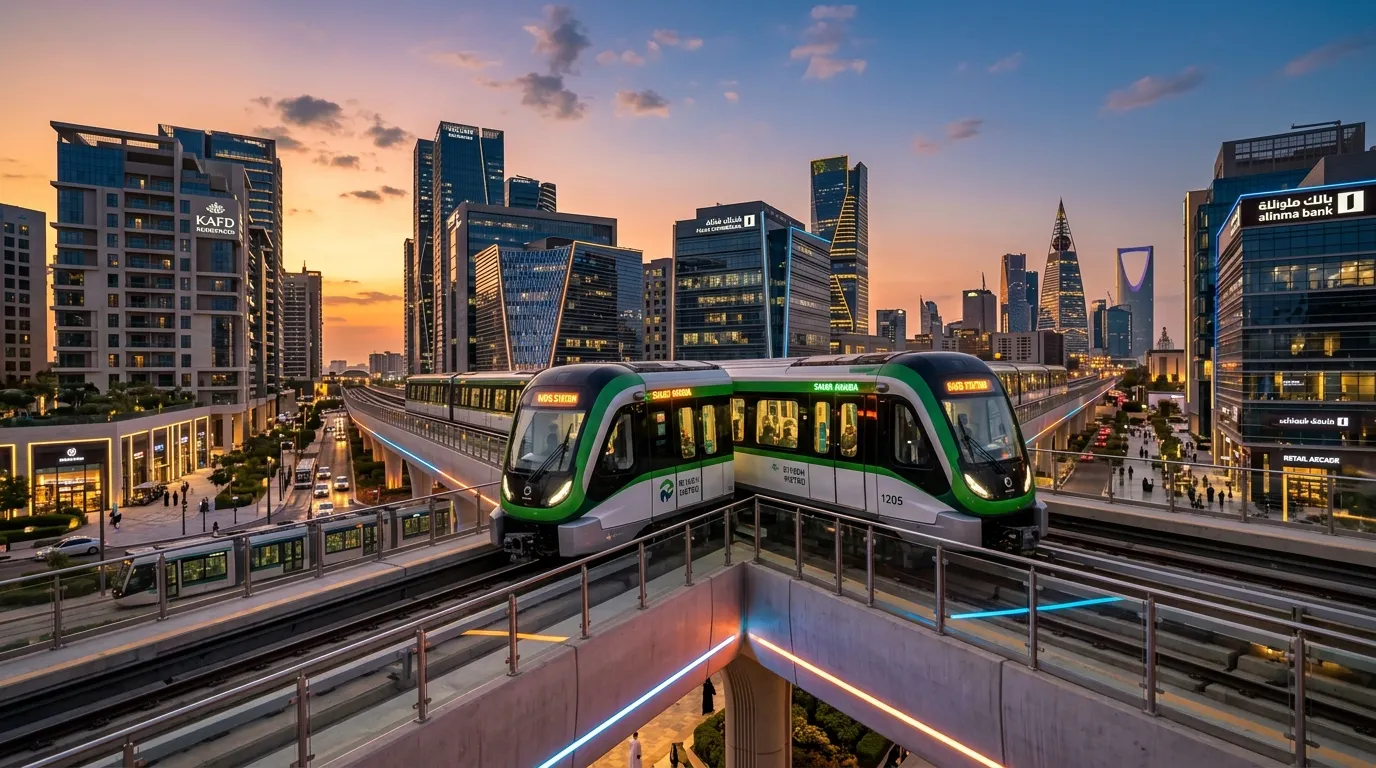

How the Riyadh Metro is Reshaping Real Estate Prices in 2026
The Riyadh Metro, a cornerstone of Saudi Arabia’s Vision 2030 infrastructure plan, is no longer a future promise—it is a fully functional reality. By 2026, this massive transit network has fundamentally rewired the city’s urban dynamics and, consequently, its real estate market.
For property investors, the old adage of “location, location, location” in Riyadh has been updated to: “How close is it to the Metro?” Here is a comprehensive look at how the Riyadh Metro is driving property values and shaping investment strategies in 2026.
Key Takeaways
- The Transit Premium: Properties within a 10 to 15-minute walk of a metro station command significant price premiums over those in unconnected areas.
- Rise of TODs: Transit-Oriented Developments (TODs)—mixed-use districts clustering around stations—are becoming the most sought-after investment hubs.
- Rent Freeze Context: With the 2026 urban rent freeze in effect, investors must prioritize high-occupancy assets (like metro-adjacent apartments) over speculative rental increases.
- Top Districts: Neighborhoods intersecting key metro lines, such as Al Malqa, Al Yasmin, and areas near KAFD, are seeing the highest liquidity.
The Metro Price Premium: Why Connectivity Pays
Before the metro, Riyadh was a heavily car-dependent city. Property values were often dictated by proximity to major highways. In 2026, the paradigm has shifted. Data shows a statistically significant relationship between a property’s distance to a metro station and its market value.
Capital Appreciation: During the final construction and operational rollout phases between 2024 and 2026, villas and apartments in metro-adjacent zones saw capital appreciation drastically outpace the broader city average—with some specific nodes experiencing up to a 70% uplift in asking prices.
Rental Demand: As traffic congestion remains a factor in a rapidly growing Riyadh, young professionals and expatriates are increasingly filtering their rental searches based strictly on metro access. This guarantees investors higher occupancy rates and lower void periods.
Transit-Oriented Development (TOD) as the New Standard
The Riyadh Metro hasn’t just provided transport; it has created entirely new micro-economies. The zones immediately surrounding major stations are evolving into Transit-Oriented Developments (TODs). These are high-density, pedestrian-friendly areas combining residential apartments, retail spaces, and corporate offices.
For investors, acquiring commercial or residential space within a designated TOD is considered the safest long-term play in 2026. These areas benefit from guaranteed footfall and government-backed infrastructure upgrades, making them highly resilient to market fluctuations.
Navigating the 2026 Market: The Rent Freeze Factor
Understanding the metro’s impact requires looking at the broader 2026 regulatory environment, specifically the recent five-year rent freeze implemented within Riyadh’s urban boundaries.
Because landlords can no longer aggressively hike rents year-over-year, the investment strategy has evolved. The focus is no longer on speculative rental yield growth, but on asset quality and consistent occupancy. Metro-adjacent properties naturally fulfill this requirement. Even with capped rents, a property that never sits empty due to high tenant demand (driven by transit access) will outperform an isolated property that struggles to attract renters.
Frequently Asked Questions
Which Riyadh districts benefit the most from the Metro?
Districts that intersect with multiple metro lines or key economic hubs are the clear winners. Look toward Northern Riyadh (Al Malqa, Al Yasmin, Al Aqiq), areas surrounding the King Abdullah Financial District (KAFD), and eastern hubs like Qurtubah and Al Munsiyah.
Is it better to buy an apartment or a villa near the Metro?
In 2026, the trend strongly favors modern, smart apartments in these transit hubs. The demographic seeking metro access (young professionals, expats, small families) prefers high-amenity apartment living over the maintenance and cost of traditional, sprawling villas.
Has the Metro caused properties further away to lose value?
They haven’t necessarily lost value, but they are experiencing much slower growth. The market has become “selective,” meaning properties lacking modern infrastructure or transit access are seeing price stagnation compared to the booming metro corridors.
Looking to secure a high-yield property on Riyadh’s most lucrative metro corridors? Contact Lebami to explore our curated portfolio of premium, transit-connected apartments.
